Centralised tracking of mutable bunch-level and per-container status flags. More...
#include <BunchStateHandler.h>
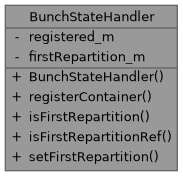
Classes | |
| struct | ContainerState |
| Per-container slot of mutable flags. One per registered ParticleContainer. Lifetime is tied to the owning container (see registerContainer() for details). More... | |
Public Member Functions | |
| BunchStateHandler ()=default | |
| std::shared_ptr< ContainerState > | registerContainer () |
Allocate a new per-container slot and return a strong reference to it. The handler itself retains only a std::weak_ptr, so the slot is destroyed automatically once the caller (typically a ParticleContainer) releases its shared_ptr. | |
| bool | isFirstRepartition () const |
| bool & | isFirstRepartitionRef () |
| Non-const reference escape hatch used by LoadBalancer::repartition. | |
| void | setFirstRepartition (bool v) |
Private Attributes | |
| std::vector< std::weak_ptr< ContainerState > > | registered_m |
| bool | firstRepartition_m = true |
Detailed Description
Centralised tracking of mutable bunch-level and per-container status flags.
Single instance per PartBunch, shared with every component that needs access (ParticleContainer, DistributionMoments, ...).
Two classes of state live here:
- Bunch-wide flags (
firstRepartition, futureemittingNow) apply to the bunch as a whole and are stored as plain members. - Per-container flags (
momentsDirty,unitlessPositions) live in the nestedContainerStatestruct. EachParticleContainerregisters itself viaregisterContainer()atsetBunchStateHandlertime and receives astd::shared_ptr<ContainerState>slot. The container holds the only strong reference; the handler keeps astd::weak_ptrso the slot is released automatically when the container is destroyed (no unregister needed). - emittingNow (aka "isEmitting"): managed by the emitting distribution itself (e.g. FlatTop sets it when t > t0 and particles are being created).
Invariants
- unitlessPositions: true while the container's positions are in the dimensionless form R' = R / (c * dt). Toggled only by ParticleContainer::switchToUnitlessPositions / switchOffUnitlessPositions. Does NOT mark the container's moments dirty (coordinate representation change only).
- momentsDirty: set whenever a physics operation mutates this container's particle positions (R) or momenta (P) – push, kick, emission, particle deletion. Cleared by DistributionMoments::computeMoments once the moments cache is consistent with the particle state.
- firstRepartition: true until the first ORB-style repartition has run for the bunch. Bunch-wide because the load balancer is shared.
MPI consistency
Every flag is conceptually consistent across MPI ranks. The OPALX option AGGRESSIVE_STATE_SYNC (see Options::aggressiveStateSync) forces every setter below to perform an ippl::Comm->allreduce with std::logical_or<bool> so ranks converge to the same (conservative) value even if a caller mutated the flag on only a subset of ranks. Default off: the allreduce on every mutation adds up, and correctly-written callers already set the same value on every rank.
Definition at line 56 of file BunchStateHandler.h.
Constructor & Destructor Documentation
◆ BunchStateHandler()
|
default |
Member Function Documentation
◆ isFirstRepartition()
|
inline |
Definition at line 92 of file BunchStateHandler.h.
References firstRepartition_m.
◆ isFirstRepartitionRef()
|
inline |
Non-const reference escape hatch used by LoadBalancer::repartition.
Bypasses the aggressive-sync setter path. The load balancer is the single well-defined caller that flips this flag from true to false on all ranks after the first repartition.
Definition at line 100 of file BunchStateHandler.h.
References firstRepartition_m.
◆ registerContainer()
| std::shared_ptr< BunchStateHandler::ContainerState > BunchStateHandler::registerContainer | ( | ) |
Allocate a new per-container slot and return a strong reference to it. The handler itself retains only a std::weak_ptr, so the slot is destroyed automatically once the caller (typically a ParticleContainer) releases its shared_ptr.
Definition at line 39 of file BunchStateHandler.cpp.
References registered_m.
Referenced by TEST_F(), TEST_F(), TEST_F(), TEST_F(), TEST_F(), TEST_F(), TEST_F(), TEST_F(), and TEST_F().
◆ setFirstRepartition()
| void BunchStateHandler::setFirstRepartition | ( | bool | v | ) |
Definition at line 45 of file BunchStateHandler.cpp.
References Options::aggressiveStateSync, and firstRepartition_m.
Member Data Documentation
◆ firstRepartition_m
|
private |
Definition at line 115 of file BunchStateHandler.h.
Referenced by isFirstRepartition(), isFirstRepartitionRef(), and setFirstRepartition().
◆ registered_m
|
private |
Definition at line 113 of file BunchStateHandler.h.
Referenced by registerContainer().
The documentation for this class was generated from the following files: